The Architecture of My Blog: Simple, Fast, and Scalable

When designing a technical blog dedicated to system design and scalability, treating the platform as a mere collection of styled templates is a missed engineering opportunity. The infrastructure powering these pages must reflect the same technical rigor as the systems I discuss here.
By decoupling the compilation layer from the delivery network, this architecture achieves a 0-millisecond Total Blocking Time (TBT) and a Speed Index of 1.1 seconds. Here is how it works.
1. CPU: Eliminating the Cost of Hydration
Modern frameworks (like Next.js or React) default to sending massive JavaScript bundles to the browser. The client’s CPU must download, parse, and execute this script to rebuild the Virtual DOM tree and make the page interactive—a process called Hydration. This process completely monopolizes the browser’s Main Thread, causing high CPU execution overhead and driving up the Total Blocking Time (TBT).
To optimize client hardware resources, I chose Astro. Instead of rendering on runtime via client-side scripts, Astro acts as an Ahead-of-Time (AOT) compiler. Its Islands Architecture processes the component lifecycle entirely during the build phase, stripping away all runtime JavaScript by default and shipping raw, structural HTML and CSS.
Because the client’s CPU only performs native parsing of static markup without executing complex script evaluation, thread concurrency is optimized. The Main Thread remains entirely unblocked, yielding a perfect 0ms TBT.
2. Network: Shifting Computation to the Edge
Optimizing client-side execution is useless if packets are throttled by physical network constraints. A traditional deployment relying on a single origin server introduces a severe Round Trip Time (RTT) penalty and inflates the TTFB (Time to First Byte) for global users due to geographical distance and multi-hop routing.
To achieve low-latency performance globally, this architecture completely bypasses central server constraints by deploying directly to Cloudflare Pages, shifting the entire delivery layout to the network perimeter.
 Visualizing the distributed routing topology across global edge nodes.
The edge deployment pipeline relies on three main architectural primitives:
- Compilation Pipeline: A
git pushtriggers an automated CI/CD worker that compiles Markdown files directly into immutable static assets. - Global Anycast Routing: Instead of relying on traditional geo-DNS, which is prone to propagation delays, the infrastructure utilizes Anycast. Multiple edge data centers advertise the exact same IP address via BGP (Border Gateway Protocol). Packets are automatically routed to the topologically closest data center through the shortest autonomous system (AS) path.
- Atomic Edge Replication: Storing data globally introduces the classic distributed systems challenge of cache consistency. Cloudflare resolves this by decoupling the asset metadata from the storage tier. When a new build is deployed, an atomic pointer update invalidates old assets across all edge caches simultaneously. This guarantees immediate global consistency without the overhead of heavy polling or eventually consistent propagation delays.
Latency Optimization at the Transport Layer
Beyond data location, the network infrastructure optimizes the TCP and TLS handshake mechanisms. In a standard architecture, establishing a secure connection requires multiple round-trips over long physical distances to negotiate keys:
3. Data-Driven Validation: The Benchmarks
In systems engineering, architectural theories must be validated by empirical data. Running production-level audits yields the following infrastructure metrics:
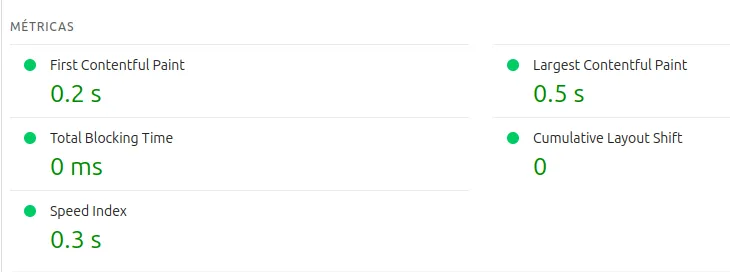 Production performance audit confirming optimal core web vitals and zero-second execution blocking.
- First Contentful Paint (0.2s) & Speed Index (0.3s): The visual layout stabilizes almost instantly. Because there are no blocking assets, the viewport renders in a fraction of a second.
- Largest Contentful Paint (0.5s): Serving resources directly from the Edge memory cache ensures that the main content is fully delivered without waiting for central server round-trips.
- Total Blocking Time (0ms): The browser’s Main Thread is completely free of client-side scripting overhead, confirming 0ms of CPU saturation.
- Cumulative Layout Shift (0): Perfect visual stability with zero layout jumps during the critical rendering path.
Optimization Note: While desktop performance is near-instantaneous, throttling tests under simulated mobile environments reveal predictable network friction on the LCP. To squeeze mobile loading times closer to desktop speeds, the next infrastructure iteration will resolve asset delivery bottlenecks. This includes optimizing raw assets by serving compressed modern image formats like WebP or AVIF mapped strictly to the layout layout, and implementing explicit resource hinting via fetchpriority="high" directives to ensure critical assets are prioritized over the network stream immediately.
Conclusion
The architecture of this blog demonstrates that modern web performance is fundamentally an infrastructure and resource-allocation problem. By shifting the computational workload to the build phase (via Astro) and moving the data delivery to the geographical perimeter of the network (via Cloudflare’s Edge), we can eliminate latency and resource saturation entirely.
When you design systems with the right architectural trade-offs, scalability becomes an inherent property of your infrastructure, not an afterthought.